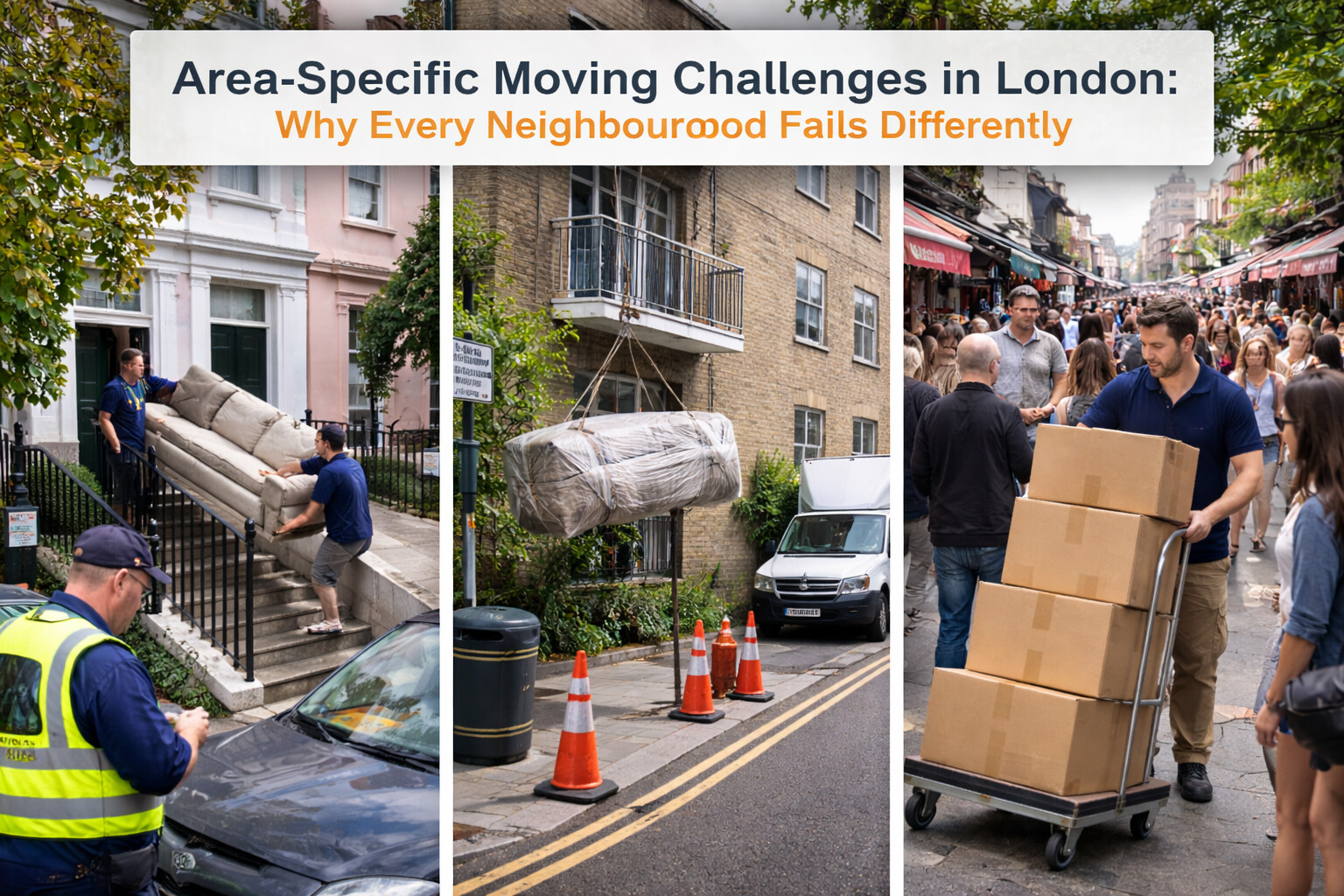



One of the biggest misconceptions in London moving is the idea that staying within the same borough makes a move simple. In reality, same-borough moves are often harder to plan correctly than longer relocations, precisely because people underestimate them.
A move from one street to another a mile away can involve two completely different access rules, parking realities, building types, and enforcement behaviours, even though both addresses sit under the same council.
This guide explains why same-borough moves are frequently misplanned, what actually changes when you move locally, and how to approach these relocations with the right mindset.
For the full set of location-based guides, see the pillar page:
https://blog.xvan.uk/areas-location-guides/
Why Same-Borough Moves Feel “Safe” — and Why That’s Risky
People often assume:
- Parking rules will be similar
- Street layout will be familiar
- Enforcement will be predictable
- Travel time will be negligible
This creates a false sense of simplicity.
In practice, boroughs are large, internally diverse, and often contain:
- Both high-density and suburban zones
- Mixed residential and commercial streets
- Areas with radically different parking enforcement intensity
The biggest risk of same-borough moves is planning laziness, not logistics.
Same Borough ≠ Same Street Conditions
Within a single borough, you can easily move between:
- A quiet residential road and a fully controlled main road
- A low-rise house and a high-rise apartment block
- A street with informal loading tolerance and one with camera enforcement
From a moving perspective, street-level rules matter more than borough name.
Parking Reality: Two Locations, Two Problems
Same-borough moves double your exposure to parking risk because you must manage two separate loading environments.
Common scenarios:
- Easy parking at origin, impossible parking at destination
- No restrictions on one street, strict CPZ on the other
- One location requires suspension, the other does not
Many “short” moves fail because people only check parking at one end.
Distance vs Complexity: Why Short Moves Aren’t Faster
Local moves reduce driving distance, but they do not reduce:
- Loading time
- Carry distance
- Stair and lift use
- Enforcement exposure
In fact:
- Short moves often involve more loading cycles
- Vans may need repositioning multiple times
- Time saved driving is lost handling access issues
A one-mile move can easily take longer than a five-mile one.
Housing Changes Within the Same Borough
A very common same-borough move is a housing upgrade or downgrade, such as:
- Flat → house
- House → flat
- Studio → one-bed
- Older building → new development
Each change alters:
- Item volume
- Furniture size
- Vertical movement
- Access rules
Treating it as “the same move, just nearby” is a major error.
Lift Access and Building Rules
Same-borough moves frequently involve:
- Different building management companies
- Different lift booking systems
- Different permitted moving hours
It is common for:
- One building to allow all-day moves
- The other to allow only limited slots
Failure to align these rules is a frequent cause of delays.
Enforcement Behaviour Can Vary Widely
Within the same borough:
- One area may be lightly patrolled
- Another may have camera enforcement
- Some streets tolerate short loading stops
- Others issue fines within minutes
Relying on past experience from “nearby” streets is unreliable.
Cost Structure of Same-Borough Moves
| Cost Factor | Same-Borough Move |
|---|---|
| Driving Distance | Low |
| Loading Time | Medium to High |
| Parking Risk | High (two locations) |
| Labour Cost | Often underestimated |
| Time Overrun Risk | High |
Local moves are time-sensitive, not distance-sensitive.
Common Same-Borough Moving Scenarios
Same-borough moves are common for:
- Renters changing flats
- Families upsizing locally
- Temporary relocations
- Renovation-related moves
- Downsizing after long residence
These moves are emotionally “local” but logistically not simple.
The Psychological Trap of Local Moves
People moving locally often:
- Pack less carefully
- Plan less thoroughly
- Book smaller vans
- Choose tighter time slots
This increases:
- Breakage risk
- Underbooking
- Stress on the day
- Unexpected extra charges
Local familiarity often leads to lower preparation quality.
How to Plan a Same-Borough Move Properly
A correct planning approach includes:
- Treating both locations as independent problems
- Checking parking and access at both ends
- Assessing housing type changes honestly
- Allowing buffer time despite short distance
- Choosing flexible services over “quick move” assumptions
Planning discipline matters more when the move looks simple.
Same-Borough vs Cross-Borough Moves
| Factor | Same Borough | Cross Borough |
|---|---|---|
| Assumed Simplicity | High | Low |
| Actual Complexity | Medium–High | Medium |
| Planning Quality | Often poor | Often better |
| Risk of Overruns | High | Moderate |
Ironically, people plan cross-borough moves more carefully, leading to fewer surprises.
Using Xvan for Same-Borough Moves
The Xvan app is particularly effective for same-borough and short-distance moves because it focuses on access and service matching, not mileage.
With Xvan, you can:
- Plan both locations independently
- Match help levels to real access conditions
- Avoid underbooking vans or labour
- Stay flexible if conditions change
Download Xvan (UK):
https://xvan.uk
Xvan treats local moves with the same seriousness as long ones.
Frequently Asked Questions
Are same-borough moves cheaper?
Not always. Time and access often matter more than distance.
Can I skip parking checks if I know the area?
No. Street-level rules vary widely, even nearby.
Are local moves faster?
Sometimes, but many take longer than expected.
Do short moves still need planning?
Yes. They fail more often due to under-planning.
Final Summary
Same-borough moves are one of the most misunderstood relocation types in London. Their apparent simplicity hides access risks, enforcement exposure, and planning traps that frequently cause delays and extra costs.
If you treat a local move with the same discipline as a long one — checking both locations, planning access properly, and choosing flexible services — it becomes smooth and predictable. If you don’t, it often becomes frustrating and expensive.
For more detailed area-based guides, visit:
https://blog.xvan.uk/areas-location-guides/