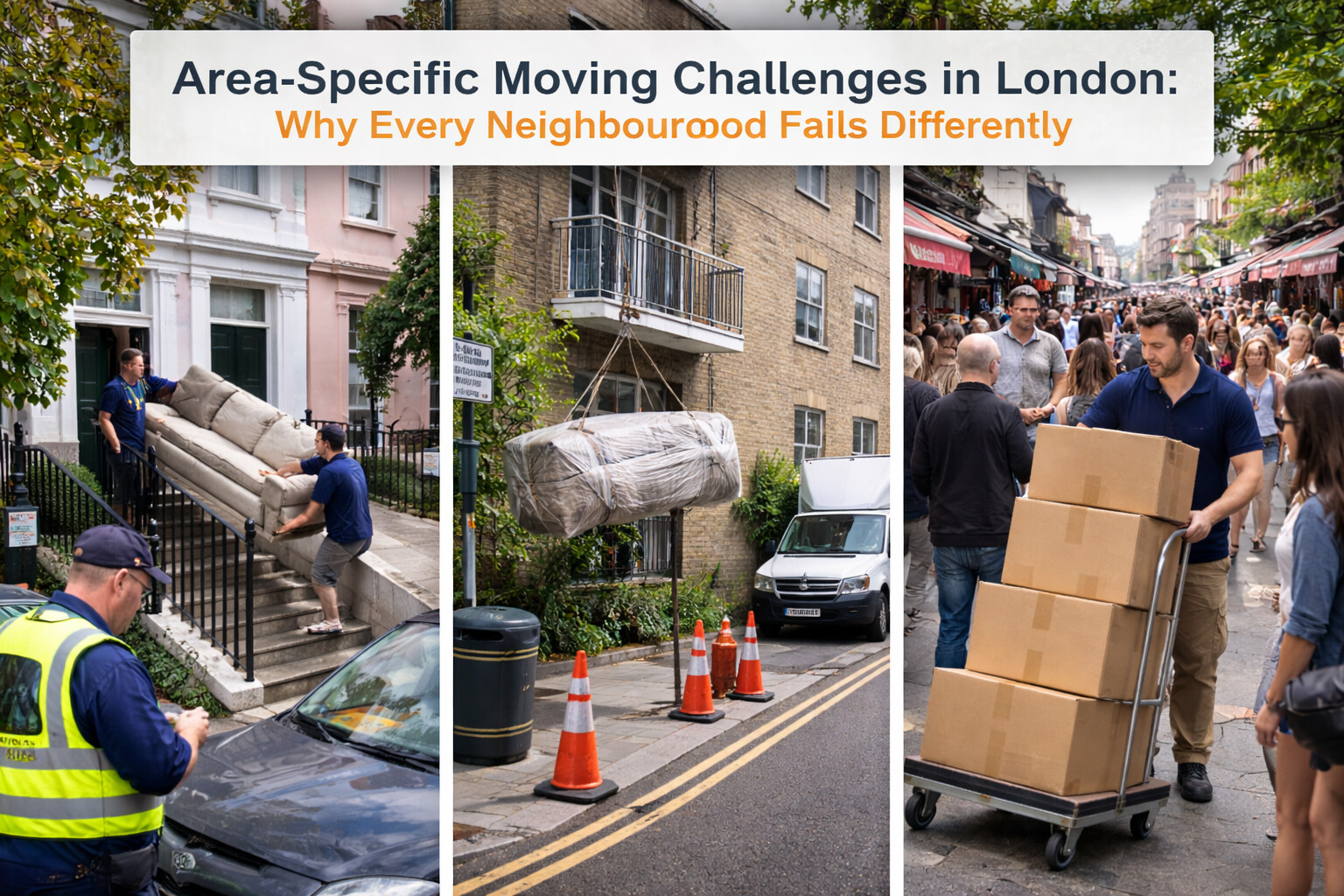



Short-distance moves within London are among the most misunderstood relocations. When two addresses are close — sometimes even on the same street — people assume the move will be quick, cheap, and low-risk. In practice, short distance removes travel time, but it does not remove access rules, enforcement, building constraints, timing pressure, or volume.
This guide explains why short-distance London moves frequently overrun, where assumptions fail, and how to plan correctly when proximity creates overconfidence, not simplicity.
For the full set of area-based guides, visit the pillar page:
https://blog.xvan.uk/areas-location-guides/
Why Short Distance Creates Planning Blindness
When a move is nearby, people often:
- Skip detailed access checks
- Choose smaller vans
- Book tighter time slots
- Assume flexibility will fix issues
This creates a dangerous mindset:
“If something goes wrong, it’s only around the corner.”
In London, what goes wrong is rarely the drive — it’s everything else.
Distance vs Complexity: What Actually Changes (and What Doesn’t)
What Short Distance Reduces
- Driving time
- Fuel cost
- Route complexity
What Short Distance Does Not Reduce
- Parking legality
- Enforcement exposure
- Carry distance
- Lift and building rules
- Loading speed
- Labour fatigue
As a result, many short moves take as long or longer than medium-distance ones.
Two Locations, Double the Risk
Short-distance moves still involve two separate loading environments:
- Origin street rules
- Destination street rules
Common scenarios:
- Easy parking at origin, impossible at destination
- No restrictions on one street, red route on the other
- One building allows moves all day, the other allows only narrow windows
Short distance does not merge these problems — it duplicates them.
The “Multiple Trips” Trap
Short moves encourage people to:
- Book smaller vans
- Accept multiple trips
In London, this often backfires because:
- Parking must be re-secured each trip
- Enforcement risk repeats
- Lift bookings may expire
- Fatigue builds quickly
Two short trips often cost more time than one properly planned trip.
Same-Street and Same-Block Moves
Moves within the same street or building feel trivial — until:
- Parking shifts between hours
- Neighbours object
- Building rules change mid-day
- Lift access is revoked
Even a 20-metre move can:
- Require legal parking planning
- Trigger enforcement
- Overrun due to access loss
Proximity does not equal permission.
Short Moves in Flats vs Houses
Flat-to-Flat Short Moves
- Lift dependency dominates
- Building rules control pace
- Timing errors are costly
House-to-House Short Moves
- Volume dominates
- Multiple floors increase fatigue
- Packing quality matters more than distance
Short distance shifts risk toward access and volume, not travel.
Enforcement Behaviour on Short Moves
Short moves often:
- Attract more enforcement, not less
- Appear as “unnecessary stopping”
- Trigger complaints from residents or businesses
Repeated stopping and starting increases visibility and risk.
Time Compression and Overruns
People book short moves tightly:
- One or two hours
- No buffer
- Fixed slots
When something slips:
- There is no recovery window
- Delays cascade instantly
- Rescheduling becomes expensive
Short moves need buffer time, not tighter booking.
Cost Patterns in Short-Distance London Moves
| Cost Driver | Impact |
|---|---|
| Distance | Low |
| Time overruns | High |
| Parking risk | High |
| Repositioning | Common |
| Underbooking | Very common |
Costs escalate because of repeated access friction, not mileage.
Common Mistakes People Make
- Booking the smallest possible van
- Planning multiple trips casually
- Skipping parking checks
- Ignoring building rules
- Assuming time can be “made up”
These mistakes are more common in short moves than long ones.
When Short Moves Are Actually Easier
Short moves can be smoother only if:
- Both locations have easy, legal parking
- Building rules are aligned
- One larger van is used
- Packing is complete before loading
Ease is conditional, not automatic.
How to Plan a Short-Distance Move Properly
A realistic short-distance plan includes:
- Treating the move like a long one
- Checking access and rules at both ends
- Choosing van size for one trip where possible
- Allowing buffer time
- Avoiding peak enforcement hours
Short distance should reduce stress — not planning quality.
Short Moves Across Different Environments
Short moves often cross:
- Quiet → busy streets
- Residential → commercial zones
- One borough micro-zone to another
Even a few hundred metres can mean completely different rules.
Always plan around the most restrictive end.
Using Xvan for Short-Distance Moves
The Xvan app is particularly effective for short-distance moves because it focuses on access and service matching, not mileage.
With Xvan, you can:
- Choose the right van size for one-trip moves
- Match help levels to access reality
- Avoid repeated enforcement exposure
- Plan flexibly instead of optimistically
Download Xvan (UK):
https://xvan.uk
Xvan treats short moves with the same discipline as long ones.
Frequently Asked Questions
Are short-distance moves cheaper?
Not always. Access and time often matter more than distance.
Is multiple trips a good idea?
Usually no, unless access is guaranteed.
Do short moves need planning?
Yes. They fail more often due to overconfidence.
Can a short move take all day?
Yes — very easily, if access goes wrong.
Final Summary
Short-distance moves in London are deceptive. They remove travel time but leave every other constraint intact — and often amplify risk through overconfidence.
If you plan short moves with the same discipline as long ones, they become efficient. If you don’t, they become some of the most frustrating and expensive moves in the city.