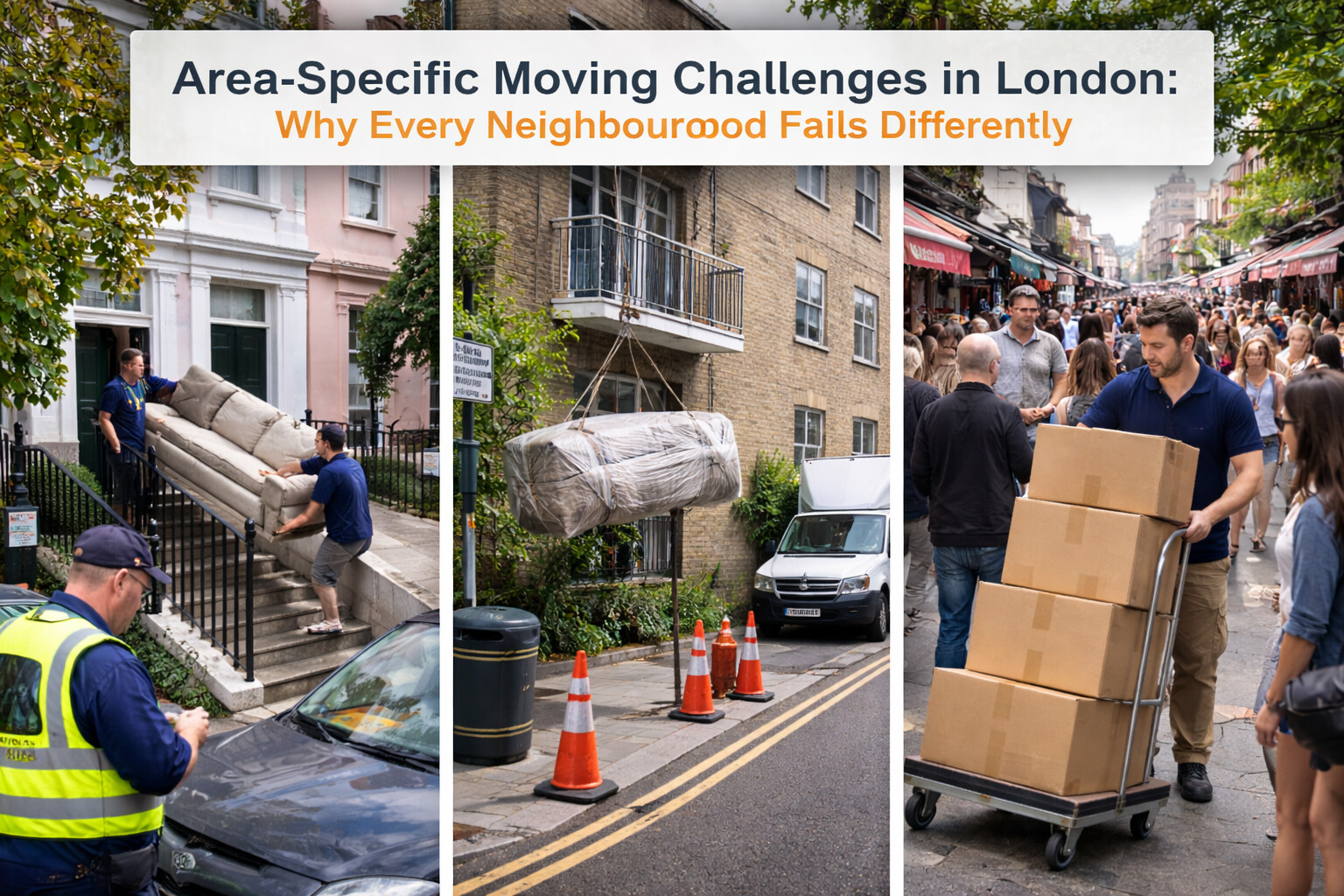



Most moving problems in London do not happen because people choose the wrong van, the wrong day, or even the wrong company. They happen because people plan their move around distance, property size, or price — instead of planning around location behaviour.
This final guide brings together everything covered in the Areas & Location Guides and turns it into a practical, repeatable framework you can use to plan any London move correctly, regardless of size or budget.
If you understand how your location behaves, the move becomes predictable.
If you don’t, even a “simple” move can collapse.
You can explore all related guides here:
https://blog.xvan.uk/areas-location-guides/
Why Location Must Be the First Decision (Not the Last)
Most people plan in this order:
- How much stuff
- How far
- How much it costs
- Where it is
Correct planning reverses this:
- Where it is
- What that location restricts
- What that location punishes
- Then size, distance, and cost
Location dictates:
- Parking feasibility
- Enforcement exposure
- Time windows
- Carry distance
- Failure patterns
Everything else is secondary.
Step 1: Identify the Dominant Location Type
Before thinking about vans or helpers, classify each end of your move.
Ask:
Which of these best describes the origin and destination?
- Central / Inner London
- High-density residential
- Apartment block / new development
- Student area
- Suburban / outer London
- Narrow or historic street
- Transport hub proximity
- Commercial / mixed-use area
You are not choosing one — you are identifying risk.
Step 2: Identify the Dominant Risk (Every Area Has One)
Every location punishes one main mistake more than others.
| Area Type | Dominant Risk |
|---|---|
| Central / Inner | Access & enforcement |
| High-density | Time compression |
| Apartment blocks | Procedural failure |
| Student areas | Timing collapse |
| Suburban | Volume underestimation |
| Narrow streets | Physical infeasibility |
| Transport hubs | Zero tolerance enforcement |
| Commercial areas | Missed windows |
Your job is not to avoid all risks — it’s to plan around the dominant one.
Step 3: Let the Hardest Location Set the Rules
If one end of your move is easy and the other is hard:
- Ignore the easy end
- Plan entirely around the hard end
Examples:
- Easy suburban house → Inner London flat
→ Plan like an Inner London move - Quiet street → transport hub area
→ Plan like a hub-zone move - House → apartment block
→ Plan like an apartment move
The easiest location never saves the hardest one.
Step 4: Translate Location Risk into Practical Decisions
Once you know the dominant risk, decisions become obvious.
If the risk is access / enforcement
- Check street-level legality
- Plan exact timing windows
- Accept carry distance
- Build buffer time early
If the risk is volume
- Upsize the van
- Finish packing early
- Assume fatigue
- Avoid multi-trip optimism
If the risk is procedural
- Get building rules in writing
- Book lifts early
- Respect time slots
- Assume zero flexibility
If the risk is timing
- Avoid peak days
- Avoid peak hours
- Add buffer
- Accept longer bookings
Location tells you what to be conservative about.
Step 5: Stop Planning by Distance (It Lies)
In London:
- Short moves often overrun
- Long moves can be smooth
- Distance rarely predicts difficulty
Replace “How far is it?” with:
- How hard is loading?
- How strict is enforcement?
- How fast can items realistically move?
Distance only matters after location constraints are solved.
Step 6: Build Buffer Where Location Is Least Forgiving
Buffer time should not be equal across the move.
Add buffer:
- At restricted origins
- Around lift bookings
- Before enforcement windows close
- Early in the day, not late
London moves fail because buffers are added at the wrong place, not because there are none.
Step 7: Accept That Some Moves Are Time-Driven, Not Price-Driven
Trying to “save money” by:
- Booking tighter slots
- Choosing smaller vans
- Planning multiple trips
almost always costs more in:
- Overruns
- Fines
- Stress
- Rebooking
In high-risk locations, time realism beats price optimisation.
Common Location-Blind Planning Errors
These cause most London move failures:
- Planning around the easiest location
- Assuming short distance = easy
- Treating modern buildings as flexible
- Ignoring street-level rules
- Letting optimism replace buffer time
All five are location mistakes, not logistics mistakes.
Location-First vs Generic Planning (Reality Check)
| Planning Style | Outcome |
|---|---|
| Generic | Unpredictable |
| Distance-based | Inconsistent |
| Price-first | Failure-prone |
| Location-first | Predictable |
Location-first planning consistently outperforms experience, quotes, and assumptions.
How Xvan Fits Into Location-First Planning
The Xvan app is built around real-world location behaviour, not generic move types.
With Xvan, you can:
- Match services to access reality
- Adjust help levels based on area risk
- Avoid underbooking in volume-heavy zones
- Avoid fines in enforcement-heavy zones
- Stay flexible where rigidity causes failure
Download Xvan (UK):
https://xvan.uk
Xvan supports how London actually behaves, street by street.
Frequently Asked Questions
Is location really more important than property size?
In London, yes — very often.
Can experience replace location planning?
No. Experience without location awareness causes overconfidence.
Do “easy” areas exist?
No. Every area is easy in one way and hard in another.
Can this framework work for any move?
Yes. It scales from single-item to full house moves.
Final Summary: The Only Rule That Matters
London does not have one moving problem — it has many location-specific ones.
If you:
- Identify where your move happens
- Understand how that location fails
- Plan around that failure
your move becomes predictable, controlled, and boring — which is exactly what a good move should be.