


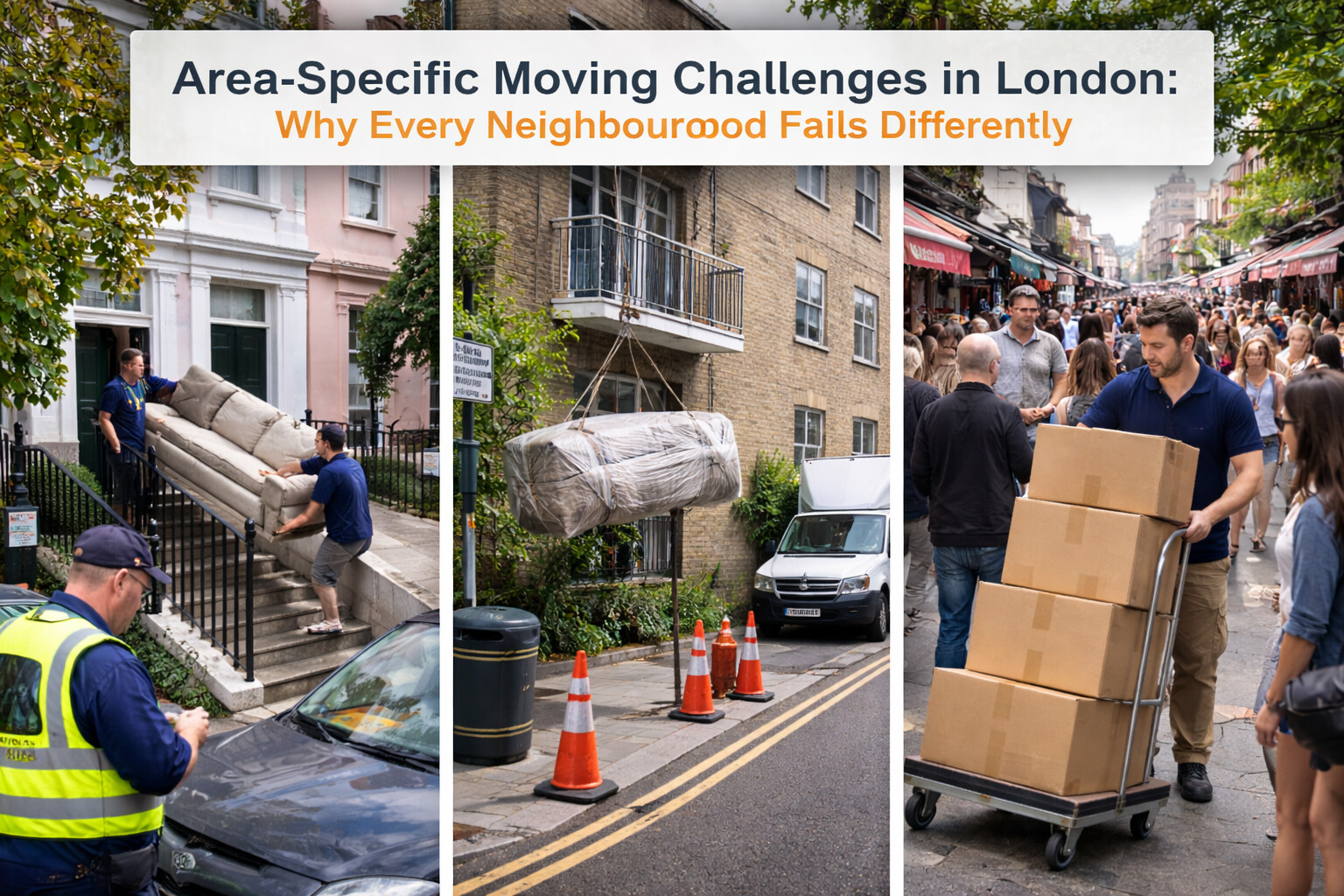
There is no such thing as a “standard London move.” Even when two moves involve the same distance, property size, and service type, the outcome can be completely different depending on where they happen. London’s neighbourhoods fail in predictable but different ways — and most problems occur when people apply the wrong assumptions to the wrong area.
This guide maps out the most common area-specific moving challenges across London, explains why they occur, and shows how to plan based on local failure patterns, not generic advice.
For the full collection of area-based guides, visit the pillar page:
https://blog.xvan.uk/areas-location-guides/
Why “Area-Specific” Matters More Than Experience
A common and dangerous belief is:
“I’ve moved in London before — I know how it works.”
In reality:
- What works in one area fails in another
- Experience is location-specific, not transferable
- Familiarity creates overconfidence
London is not one environment. It is dozens of micro-environments, each with its own dominant risk.
The Five Core Categories of Area-Specific Failure
Across London, almost all moving problems fall into one of these categories — but different areas trigger different categories.
- Access denial
- Enforcement pressure
- Volume underestimation
- Timing collapse
- Fatigue accumulation
The mistake is not encountering these problems — it’s encountering the wrong one unprepared.
Central & Inner Areas: Access-Driven Failure
Dominant Challenge
Access and legality
Typical problems:
- No legal stopping space
- Red routes and camera enforcement
- Time-limited loading
- Pedestrian congestion
Failure pattern:
- Move stalls early
- Time is lost immediately
- Recovery becomes impossible
Planning mistake:
- Focusing on item count instead of access feasibility
High-Density Residential Zones: Time Compression Failure
Dominant Challenge
Too many constraints at once
Typical problems:
- Shared lifts
- Competing moves
- Limited parking
- Building rules
Failure pattern:
- Small delays cascade
- Lift windows expire
- Waiting time explodes
Planning mistake:
- Tight bookings with no buffer
Apartment Blocks & New Developments: Procedural Failure
Dominant Challenge
Rules overrun reality
Typical problems:
- Lift booking denial
- Concierge refusal
- Time-slot enforcement
- Damage liability stops
Failure pattern:
- Move stops entirely, not slowly
- Rescheduling becomes necessary
Planning mistake:
- Treating modern buildings as flexible
Student Areas: Timing & Turnover Failure
Dominant Challenge
Peak-day overload
Typical problems:
- Multiple moves on same day
- Lift and corridor congestion
- Parking saturation
- Zero tolerance windows
Failure pattern:
- Chain delays
- Missed handover times
- Forced storage or rebooking
Planning mistake:
- Booking “small” moves during peak season
Suburban & Outer Areas: Volume Failure
Dominant Challenge
Scale, not restriction
Typical problems:
- Too much furniture
- Storage spaces forgotten
- Vans too small
- Fatigue slows pace
Failure pattern:
- Move starts smoothly
- Pace collapses mid-day
- Multiple trips cause overruns
Planning mistake:
- Underbooking capacity
Historic & Narrow Streets: Feasibility Failure
Dominant Challenge
Physical impossibility
Typical problems:
- Vans cannot enter
- No turning space
- Immediate complaints
- Emergency access issues
Failure pattern:
- Move cannot begin properly
- Forced plan changes mid-move
Planning mistake:
- Choosing van size without street checks
Transport Hub Areas: Enforcement Failure
Dominant Challenge
Zero tolerance
Typical problems:
- Red routes
- Bus lanes
- Camera enforcement
- Pedestrian safety controls
Failure pattern:
- Immediate fines
- Forced relocation
- Lost loading windows
Planning mistake:
- Assuming “quick stop” is allowed
Quiet Residential Streets: Underestimation Failure
Dominant Challenge
False security
Typical problems:
- Larger volume than expected
- Packing delays
- Fatigue
- Neighbour complaints
Failure pattern:
- Slow, creeping overrun
- Late finish
Planning mistake:
- Planning casually because the street looks easy
Short-Distance Moves: Overconfidence Failure
Dominant Challenge
Planning blindness
Typical problems:
- Multiple trips
- Repeated enforcement exposure
- Lift rebooking issues
Failure pattern:
- Time lost repeatedly
- No buffer to recover
Planning mistake:
- Tight bookings based on proximity
Mixed-Area Moves: Mismatch Failure
Dominant Challenge
Wrong rules applied to the wrong end
Typical problems:
- Easy origin, hard destination (or vice versa)
- Planning based on the easier location
Failure pattern:
- Collapse at the restrictive end
Planning mistake:
- Not planning around the hardest location
How to Identify Your Area’s Primary Risk
Ask:
- Is access likely to be denied?
- Is enforcement aggressive?
- Is volume the main issue?
- Are rules procedural and rigid?
- Is timing highly compressed?
Your answer tells you what kind of move this is, regardless of distance.
Area-Driven Planning vs Generic Planning
| Planning Style | Outcome |
|---|---|
| Generic | Overruns, fines, stress |
| Area-aware | Predictable, controlled |
| Experience-based | Inconsistent |
| Risk-based | Reliable |
Area awareness consistently outperforms experience alone.
How to Plan Based on Area-Specific Risk
A correct approach:
- Identify the dominant area risk
- Plan around that risk first
- Let other factors adapt around it
- Build buffer time where the risk is highest
- Avoid one-size-fits-all assumptions
This approach prevents most London moving failures.
Using Xvan for Area-Specific Planning
The Xvan app is designed to match moving services to area-specific risk, not generic move types.
With Xvan, you can:
- Match van size to street feasibility
- Adjust help levels for volume or access
- Avoid underbooking in high-risk areas
- Plan flexibly around local constraints
Download Xvan (UK):
https://xvan.uk
Xvan focuses on where moves fail, not just how far they go.
Frequently Asked Questions
Is any area truly “easy” to move in?
No. Each area is easy in one way and hard in another.
Can experience replace planning?
No. Experience without area awareness causes mistakes.
Which areas fail most often?
High-density, student, and central areas — due to timing and access.
Can planning eliminate all risk?
No, but it removes most predictable failures.
Final Summary
London moves fail in area-specific ways. The problem is not the city — it’s applying the wrong assumptions to the wrong neighbourhood.
If you identify how your area tends to fail and plan around that risk, your move becomes controlled and predictable instead of stressful and reactive.