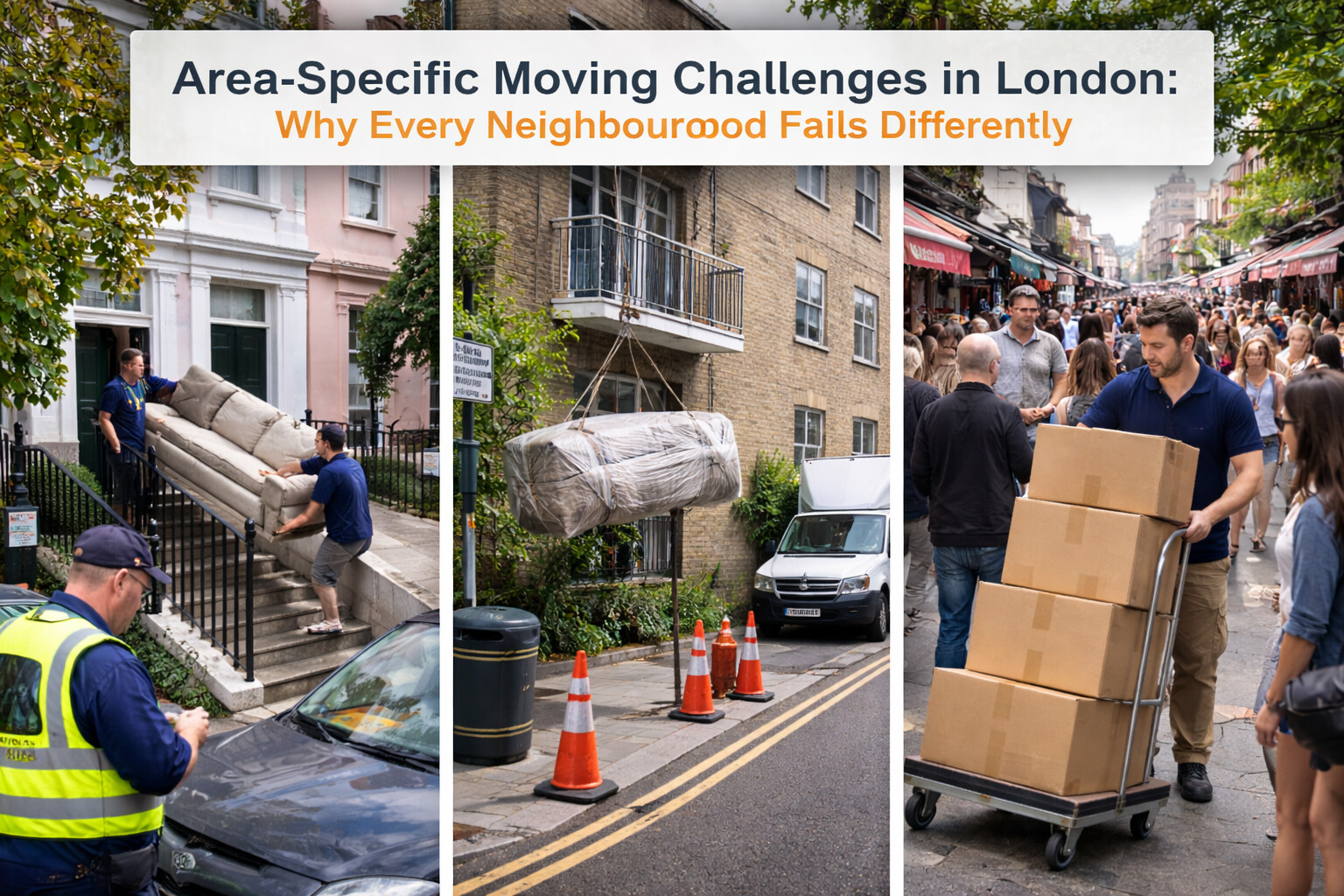



Moving within Greater London towns sits between two worlds. These areas are neither inner-city London nor fully regional towns. They combine suburban housing, longer distances, lighter enforcement, and London-wide traffic effects in ways that are easy to misjudge.
People often assume that once they are “out of London proper,” moving becomes simple. In reality, Greater London towns introduce border effects: longer drives, mixed enforcement behaviour, commuter traffic, and larger household volumes — all of which change how a move behaves.
This guide explains how moves in Greater London towns actually work, where planning assumptions fail, and how to plan correctly when space increases but London complexity does not disappear.
For the full collection of area-based guides, visit the pillar page:
https://blog.xvan.uk/areas-location-guides/
What Are Greater London Towns (From a Moving Perspective)?
From a moving and logistics point of view, Greater London towns are:
- Outer London population centres
- Areas with town-style high streets
- Locations with strong commuter links
- Predominantly residential neighbourhoods
They often include:
- Larger housing stock
- Longer-term residents
- Car-dependent layouts
- Fewer inner-city restrictions
However, they remain tied to London-wide traffic, pricing, and demand patterns.
Why Greater London Town Moves Are Misjudged
People often assume:
- Parking will always be easy
- Enforcement will be minimal
- Distance will be the main cost
- Moves will feel “non-London”
In reality:
- High streets still enforce loading rules
- Commuter traffic dominates peak hours
- Distances magnify underbooking mistakes
- Volume increases significantly
Greater London towns are volume-and-distance driven, but still affected by London behaviour.
Housing Patterns in Greater London Towns
Family Housing Dominance
These areas typically feature:
- Semi-detached and detached houses
- Gardens, sheds, and garages
- Multiple bedrooms
- Long-term accumulation of items
This means:
- High furniture count
- Bulky items
- More disassembly and reassembly
Moves here are physically demanding, not access-restricted.
Flats Above High Streets
Many Greater London towns include:
- Flats above shops
- Mixed residential–commercial buildings
These introduce:
- Limited rear access
- Time-restricted loading
- Pedestrian congestion
They behave more like Inner London micro-zones, even when surrounded by suburbia.
Distance Becomes a Major Planning Variable
Unlike Inner London:
- Driving time matters
- Multiple trips cost real time
- Traffic conditions affect schedules
Underbooking vans in these areas often leads to:
- Long overruns
- Fatigue-driven inefficiency
- Increased labour costs
Distance amplifies mistakes.
Commuter Traffic: The Hidden Constraint
Greater London towns are strongly affected by:
- Morning inbound commuter flow
- Evening outbound commuter flow
- School-run congestion
Moves that ignore these patterns:
- Lose time unexpectedly
- Miss planned schedules
- Overrun late into the day
Scheduling against commuter flow is critical.
Parking and Enforcement Reality
Residential Streets
- Parking is usually available
- Driveways are common
- Enforcement is lighter
Town Centres and High Streets
- Time-restricted loading
- Active enforcement
- Shared bays
- Pedestrian priority zones
A move that touches both environments must plan for both rule sets.
Volume vs Efficiency Trade-Off
Greater London town moves often face:
- High volume
- Easy access
- Long total handling time
This creates a false sense of control early in the move, followed by:
- Fatigue
- Slowing pace
- Late overruns
Efficiency planning matters more than speed.
Cost Patterns in Greater London Town Moves
| Cost Driver | Impact |
|---|---|
| Volume | Very high |
| Distance | High |
| Van size | Critical |
| Labour fatigue | Common |
| Time overruns | Frequent |
Costs escalate due to scale, not restrictions.
Common Mistakes People Make
- Booking vans too small
- Underestimating storage areas
- Ignoring commuter traffic
- Treating town centres as residential
- Packing on the day
These errors are systematic in Greater London towns.
Border Effects: London Rules Still Apply
Even in outer towns:
- ULEZ may still apply
- London pricing expectations persist
- Demand remains high in peak seasons
Assuming “it’s not really London” often leads to pricing and timing surprises.
How to Plan a Greater London Town Move Properly
A solid plan includes:
- Full volume assessment
- Correct van sizing
- Traffic-aware scheduling
- Differentiating residential vs town-centre access
- Allowing buffer time for fatigue
In these areas, scale replaces restriction as the main risk.
Greater London Towns vs Inner London
| Factor | Greater London Towns | Inner London |
|---|---|---|
| Access | Easy | Restricted |
| Volume | High | Low–Medium |
| Distance | High | Low |
| Enforcement | Mixed | Strict |
| Main Risk | Underbooking | Access denial |
Different environments, different failures.
Using Xvan for Greater London Town Moves
The Xvan app is well suited to large, distance-heavy moves common in Greater London towns.
With Xvan, you can:
- Choose van sizes based on real volume
- Match help levels to physical workload
- Avoid underbooking
- Plan realistically for longer routes
Download Xvan (UK):
https://xvan.uk
Xvan adapts to how outer London moves actually behave, not assumptions.
Frequently Asked Questions
Are Greater London town moves cheaper?
Often yes, but only if volume and distance are planned correctly.
Is parking always easy?
Residentially yes; town centres often no.
Do these moves take longer?
Yes, due to volume and travel time.
Can I do it in one trip?
Only if van size is realistic.
Final Summary
Greater London towns shift the moving challenge from access restrictions to scale, distance, and endurance. Wider streets and easier parking help, but they do not reduce the amount of work involved.
Successful moves depend on honest volume assessment, correct vehicle choice, and traffic-aware scheduling — not assumptions about ease.