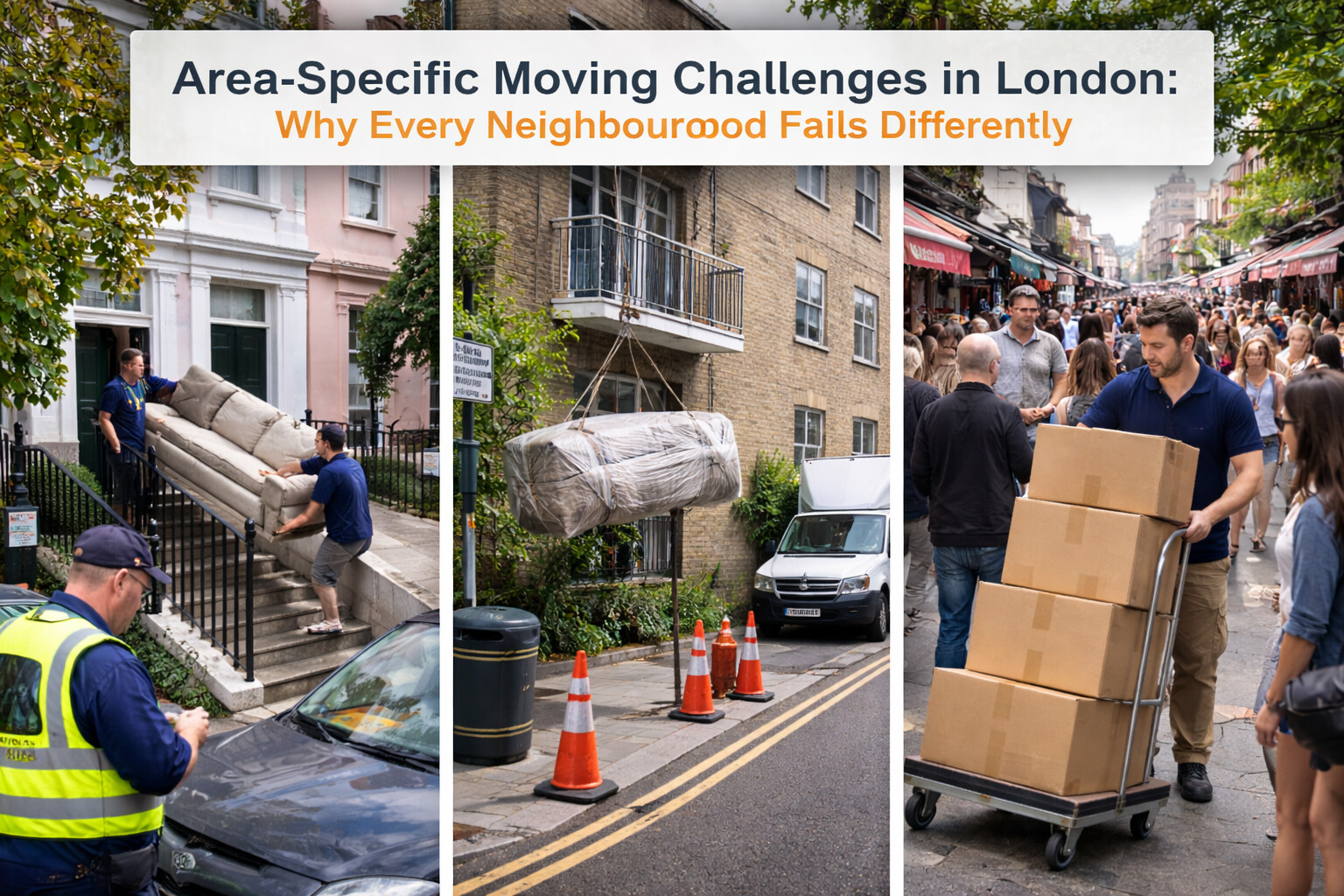



In London, postcodes are not just for navigation — they are one of the most reliable indicators of how a move will actually behave. Two properties with the same size and distance can result in completely different moving experiences simply because they sit in different postcode areas.
This guide explains how London postcode areas affect moving logistics, why postcodes are often more predictive than borough names, and how to plan realistically based on postcode-level behaviour rather than assumptions.
For the full set of location-based guides, visit the pillar page:
https://blog.xvan.uk/areas-location-guides/
Why Postcode Areas Matter More Than People Think
London postcodes reflect:
- Historical development patterns
- Street layout and density
- Housing types
- Parking culture and enforcement
- Typical access difficulty
While boroughs set rules, postcode areas reveal patterns. Movers often recognise difficulty by postcode faster than by council name.
In practice, postcodes strongly influence:
- Van access
- Carry distance
- Likelihood of parking issues
- Time overruns
- Risk of fines
Overview of Major London Postcode Areas
London is commonly grouped into broad postcode zones, each with consistent moving characteristics:
- N – North London
- NW – North West London
- E – East London
- SE – South East London
- SW – South West London
- W – West London
Each behaves differently in real-world moving scenarios.
N Postcode Area: Density, Hills & Mixed Housing
The N postcode area typically includes:
- High-density residential zones
- Victorian terraces and conversions
- Hilly streets and uneven terrain
Moving implications:
- Narrow streets increase carry distance
- Hills slow loading speed
- Parking enforcement is common
- Flat moves can be deceptively time-consuming
Moves in N postcodes often require extra labour time, even for small volumes.
NW Postcode Area: Variety and Unpredictability
The NW postcode area is one of the most diverse in London.
It includes:
- Dense inner-city streets
- Quiet suburban roads
- Large family homes
- Flats near transport hubs
Moving implications:
- Difficulty varies dramatically by street
- Van size selection is critical
- Parking can be easy or extremely restricted
NW moves often fail when people generalise based on one past experience.
E Postcode Area: Density, Regeneration & Vertical Moves
The E postcode area is shaped by:
- High-rise developments
- Regeneration zones
- Heavy renter turnover
Moving implications:
- Lift bookings are common
- Enforcement is consistent
- Vertical movement dominates time cost
- Short-distance moves are still complex
E postcode moves are time-heavy, not distance-heavy.
SE Postcode Area: Volume, Terraces & Rail Divisions
The SE postcode area is known for:
- Long terraced streets
- Family housing
- Rail-divided neighbourhoods
Moving implications:
- Larger item volumes
- Long carry distances from legal parking
- Detours due to rail infrastructure
SE moves often take longer than expected due to volume and layout, not congestion.
SW Postcode Area: Expectations, Control & Premium Access
The SW postcode area includes:
- High-value residential zones
- Strict parking controls
- Managed apartment buildings
Moving implications:
- Parking suspensions are frequently required
- Enforcement is fast
- Access coordination is essential
- Delays are expensive
SW postcode moves demand precision and preparation.
W Postcode Area: Wide Streets, Strict Rules
The W postcode area often looks easy but behaves strictly.
It is characterised by:
- Wide residential streets
- Strong parking enforcement
- High expectation environments
Moving implications:
- Easy access does not mean legal access
- Setup time is significant
- Coordination matters more than speed
W postcode moves are unforgiving of casual planning.
Postcode vs Borough: Which Matters More?
| Factor | Postcode Area | Borough |
|---|---|---|
| Street layout | Strong indicator | Moderate |
| Housing type | Strong indicator | Moderate |
| Parking behaviour | Predictive | Rule-based |
| Move difficulty | High correlation | Medium |
In practice, postcode tells you how a move feels, while borough tells you what is legally allowed.
Cost Patterns by Postcode Area
Industry patterns show:
- E and N postcodes often exceed time estimates
- SE and NW postcodes exceed volume estimates
- SW and W postcodes have higher enforcement-related costs
This is why postcode-aware planning reduces overruns.
Common Postcode-Related Mistakes
- Treating all London postcodes the same
- Planning by distance instead of access
- Ignoring vertical movement in E postcodes
- Underestimating volume in SE postcodes
- Assuming wide streets mean easy loading
These errors are postcode-specific, not random.
How to Plan Using Postcode Awareness
A postcode-aware plan includes:
- Identifying postcode area first
- Adjusting expectations based on known patterns
- Checking street-level access early
- Choosing flexible services
- Planning around the most restrictive postcode
Postcodes should inform planning, not just navigation.
Using Xvan for Postcode-Based Moves
The Xvan app is designed to adapt to postcode-driven moving patterns across London.
With Xvan, you can:
- Match services to postcode behaviour
- Adjust help levels for density or volume
- Avoid underestimating time or capacity
- Plan realistically instead of optimistically
Download Xvan (UK):
https://xvan.uk
Xvan works with how London actually behaves, postcode by postcode.
Frequently Asked Questions
Does postcode matter more than borough?
Often yes, especially for access and housing patterns.
Are some postcodes always harder?
No, but some are more unpredictable.
Can two NW moves be completely different?
Yes. NW is one of the most varied postcode areas.
Should I plan based on the hardest postcode?
Always plan around the most restrictive location.
Final Summary
London postcode areas offer one of the clearest signals of how a move will really unfold. They reveal patterns in density, access, housing, and enforcement that borough names alone cannot.
If you plan your move using postcode behaviour — not assumptions — you reduce delays, costs, and stress before the move even begins.
For more detailed location-based guides, visit:
https://blog.xvan.uk/areas-location-guides/