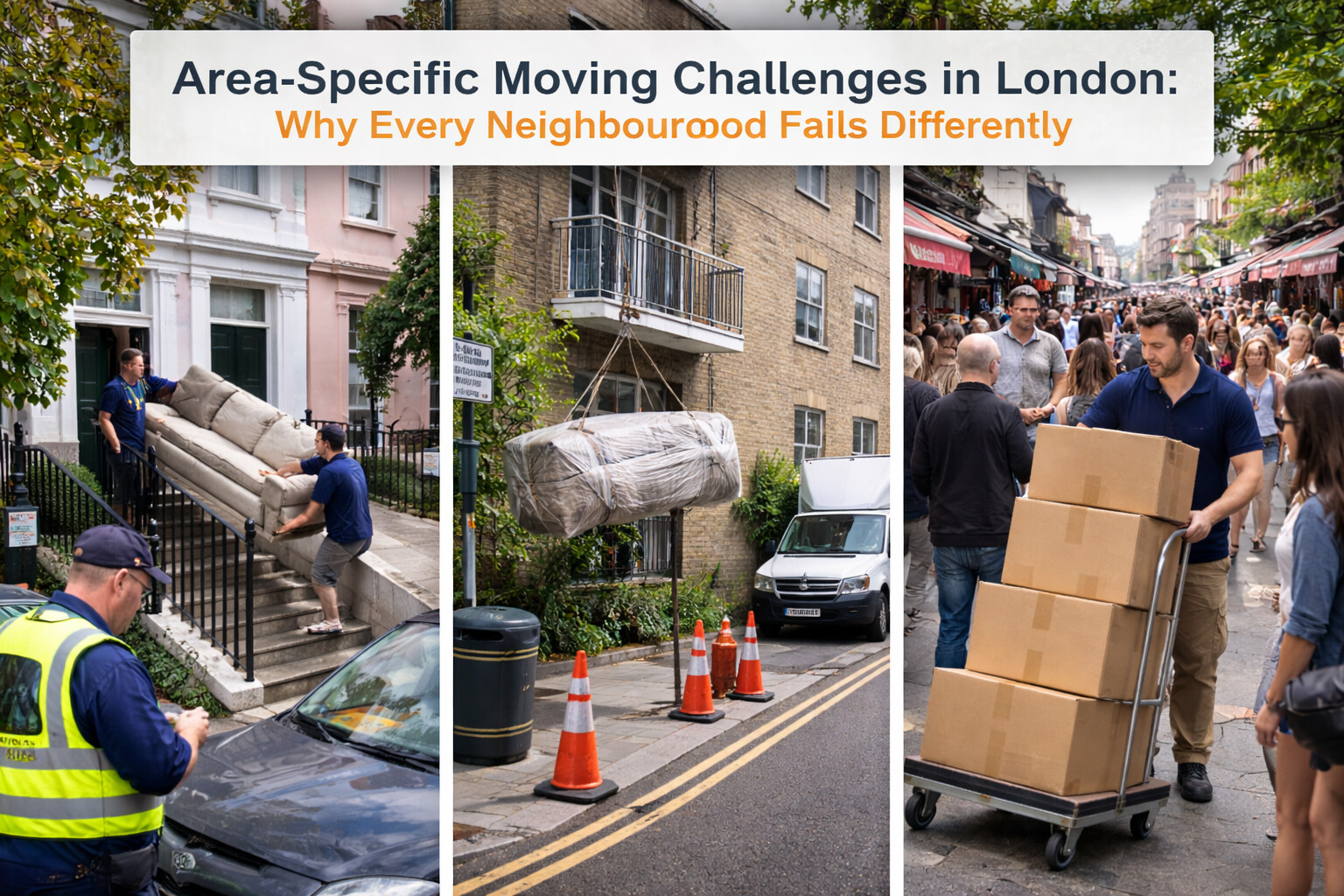



Moving in Central London is fundamentally different from moving anywhere else in the UK. Even experienced movers often underestimate how traffic controls, parking enforcement, access limits, and timing restrictions combine to turn a simple move into a complex logistical operation.
This guide explains how moving in Central London actually works, what makes it difficult, what people get wrong most often, and how to plan properly so you avoid delays, fines, and unnecessary costs.
For an overview of all location-based guides, visit the main pillar page:
https://blog.xvan.uk/areas-location-guides/
What Counts as Central London?
Central London generally includes areas within and around Central London, covering high-density business, residential, and mixed-use zones. This typically includes (but is not limited to):
- The City of London
- Westminster
- Camden (central parts)
- Kensington & Chelsea (central zones)
- Parts of Southwark and Lambeth
These areas share similar challenges:
- Extreme traffic density
- Controlled parking zones (CPZs)
- Strict enforcement
- Narrow or one-way streets
- High-rise and managed buildings
From a moving perspective, Central London behaves as a restricted logistics environment, not a normal residential area.
Why Central London Moves Are More Complex
1. Traffic Congestion Is Structural, Not Occasional
Traffic in Central London is not limited to rush hour. Congestion is:
- Constant throughout the day
- Influenced by roadworks, protests, events, and deliveries
- Highly sensitive to time windows
Even short-distance moves can take significantly longer than expected.
2. Parking Is the Primary Constraint
In Central London:
- Most streets are within Controlled Parking Zones
- Loading bays are time-limited
- Illegal stopping is enforced aggressively
Common outcomes of poor planning:
- Vans forced to park far from the property
- Increased carry distance and labour time
- Parking fines (£65–£130 per ticket)
- Aborted or delayed loading
Parking is often the deciding factor in whether a Central London move succeeds or fails.
Parking Suspensions: When They Are Essential
A parking suspension temporarily reserves space for a moving vehicle. In Central London, this is often not optional.
When you should strongly consider a suspension:
- Moving from a busy street
- Using a medium or large van
- Moving during weekday daytime hours
- Accessing managed or commercial buildings
Approval times vary by borough and can range from several days to over a week. Last-minute requests are a common and costly mistake.
Building Types and Access Issues
Central London has a high concentration of:
- Apartment blocks
- Concierge buildings
- Mixed residential–commercial properties
Typical access challenges include:
- Limited lift availability
- Booking lift slots in advance
- Restrictions on moving hours
- Security sign-in procedures
Failing to coordinate with building management often results in:
- Waiting time charges
- Missed loading windows
- Forced rescheduling
Time Restrictions and Enforcement Windows
Many Central London streets enforce:
- No-loading periods
- Morning and evening restrictions
- Weekend-specific rules
Enforcement is typically:
- Automated (cameras)
- Immediate
- Non-negotiable
Assuming “it will be fine for 10 minutes” is one of the most expensive assumptions people make.
Central London vs Other Areas: A Practical Comparison
| Factor | Central London | Outer London |
|---|---|---|
| Traffic | Constant | Variable |
| Parking | Highly restricted | More flexible |
| Enforcement | Strict | Moderate |
| Move Timing | Critical | Flexible |
| Risk of Delays | High | Lower |
Central London moves demand precision, not improvisation.
Cost Impact of Central London Conditions
Data from urban logistics and housing studies shows:
- Central moves take 30–60% longer on average
- Carry distance is often doubled due to parking limits
- Labour costs increase due to waiting and access delays
The cheapest quote is rarely the cheapest outcome in Central London.
Common Mistakes People Make
- Assuming distance = cost
- Ignoring parking rules
- Not checking building access rules
- Booking inflexible time slots
- Underestimating enforcement risk
Most Central London moving problems are predictable and avoidable.
How to Plan a Central London Move Properly
A realistic planning process includes:
- Confirming exact street restrictions
- Checking borough parking policies
- Speaking with building management early
- Allowing buffer time
- Choosing flexible services
Planning is more important than speed.
Using Xvan for Central London Moves
The Xvan app is designed for real-world urban moves, including Central London conditions.
With Xvan, you can:
- Match services to location-specific constraints
- Choose flexible loading and access options
- Avoid paying for unnecessary services
- Reduce risk through better planning
Download Xvan (UK):
https://xvan.uk
Xvan focuses on how your move actually works, not generic assumptions.
Frequently Asked Questions
Is moving in Central London more expensive?
Usually yes, due to longer loading times, access issues, and parking restrictions.
Do I always need a parking suspension?
Not always, but in many Central London streets it is strongly recommended.
Are weekend moves easier?
Sometimes, but restrictions and enforcement still apply. Always check locally.
Can small moves still be difficult?
Yes. Item count matters less than access, timing, and location.
Final Thoughts
Central London moves are not difficult because of distance or volume — they are difficult because of restrictions, enforcement, and access reality. Treating them like standard moves is the fastest way to run into problems.
Plan based on location, not assumptions.
For more area-specific guides, visit:
https://blog.xvan.uk/areas-location-guides/