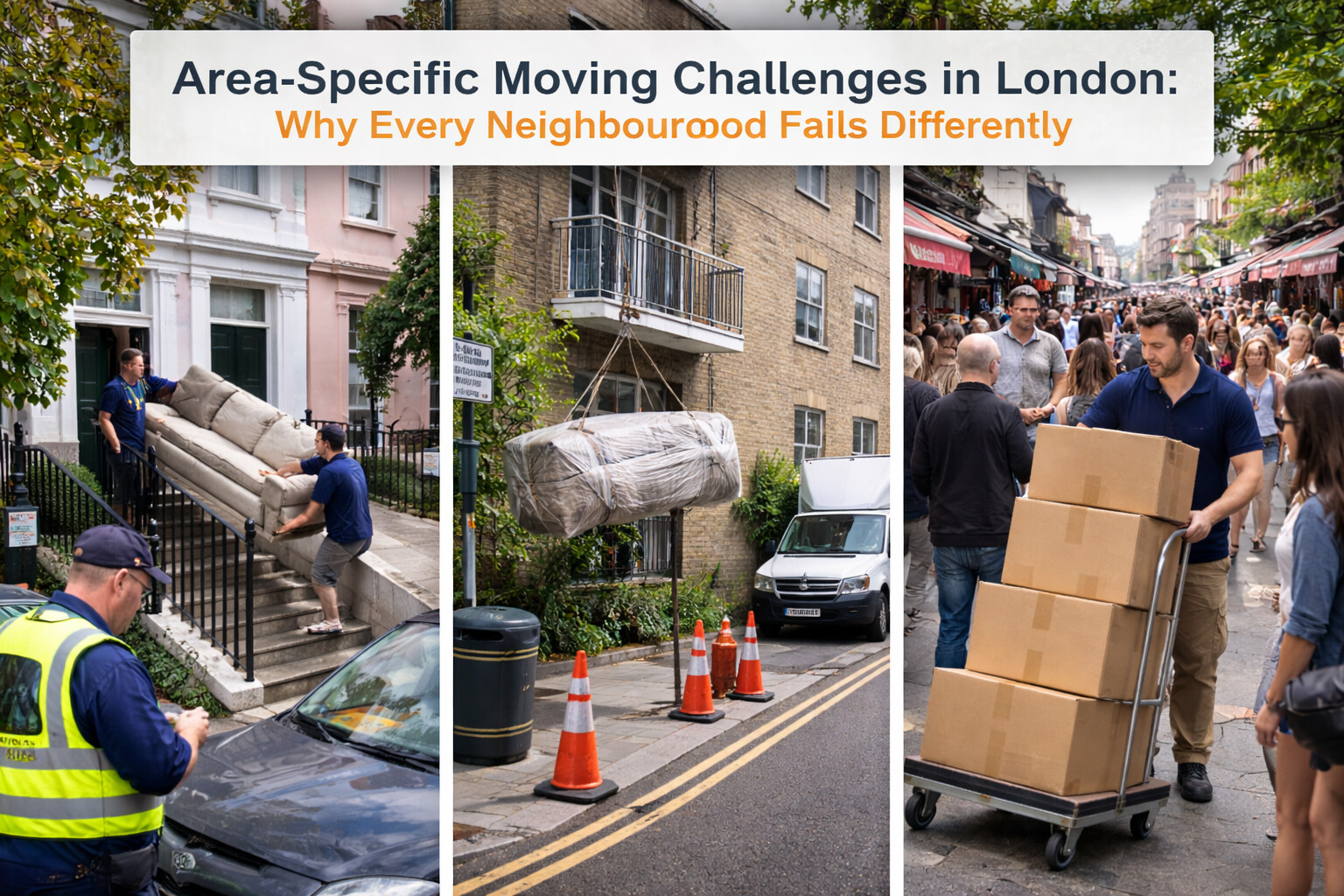


Moving in South London is very different from moving in North or Central London. While South London is often assumed to be “easier” because it is more residential, this assumption is only partly true. In practice, South London presents a unique mix of wide suburban roads, dense terraced housing, railway-divided neighbourhoods, and borough-specific parking rules that can either simplify or seriously complicate a move.
This guide explains how moving in South London actually works, what makes it unpredictable, where people go wrong most often, and how to plan properly based on real-world conditions rather than reputation.
You can find the full set of location-based guides on the pillar page:
https://blog.xvan.uk/areas-location-guides/
Why South London Is Often Misunderstood
South London has a reputation for being:
- Less congested than Central London
- More residential and family-oriented
- Easier for vans and access
While this can be true in some areas, South London also includes:
- Very dense terraced streets
- Long roads with no legal stopping
- Heavy reliance on rail corridors
- Boroughs with strict parking enforcement
The result is that two moves only a few miles apart can feel completely different in difficulty, cost, and time.
Street Design and Layout: A Major Factor in South London
South London streets tend to fall into a few common patterns, each with different moving implications.
Long Residential Terraces
- Cars parked continuously on both sides
- Few legal loading gaps
- Carry distance becomes a major issue
- Parking enforcement is often street-specific
Wide Suburban Roads
- Easier van access
- Higher chance of legal parking
- Faster loading
- Larger move volumes common
Railway-Cut Neighbourhoods
Many South London areas are divided by rail lines, creating:
- Limited access routes
- Detours for vans
- Traffic bottlenecks during peak hours
This often increases travel time even for short-distance moves.
Parking Rules in South London: Not as Relaxed as People Think
A common myth is that South London parking is “easy.” In reality:
- Many boroughs operate Controlled Parking Zones
- Restrictions vary street by street
- Enforcement is active in residential areas
- Parking suspensions are often required on busy roads
One of the biggest mistakes people make is assuming they can “just stop outside” because the street looks quiet.
Housing Stock and How It Affects Moves
South London has one of the widest housing mixes in London.
Victorian & Edwardian Terraces
- Multiple floors
- Narrow staircases
- Tight doorways
- Long internal carry distances
Post-War Purpose-Built Flats
- Often no lifts
- Shared entrances
- Restricted communal areas
Semi-Detached & Detached Homes
- Easier external access
- Larger volume of items
- More furniture-heavy moves
Each housing type affects:
- Time per item
- Required manpower
- Van loading strategy
South London moves are often volume-driven, not distance-driven.
Density vs Distance: A South London Reality
Unlike Central London, where restriction is the main problem, South London often struggles with:
- High item volume
- Long carries from legal parking
- Repeated loading trips
Data from moving industry averages shows:
- Moves in terraced South London streets often take 30–45% longer than expected
- Carry distance is one of the top hidden cost drivers
- Labour time increases faster than mileage costs
This is why cheap hourly quotes often fail in South London.
Inner vs Outer South London Differences
| Factor | Inner South London | Outer South London |
|---|---|---|
| Density | High | Moderate |
| Parking | Restricted | More flexible |
| Street Width | Narrow | Wider |
| Move Volume | Medium | High |
| Planning Complexity | High | Moderate |
Inner South London can behave similarly to Central London, while outer areas behave more like suburban zones — but with larger homes.
Common Moving Scenarios in South London
South London frequently sees:
- Family relocations
- Long-term residential moves
- Furniture-heavy moves
- Renovation-related temporary moves
These scenarios require:
- Larger vans
- Longer loading times
- More careful planning of access
Treating them like small, quick moves is a common and costly error.
Typical Mistakes People Make When Moving in South London
- Underestimating item volume
- Ignoring carry distance from legal parking
- Assuming parking is “relaxed”
- Choosing vans too small for the move
- Not planning for rail-divided routes
Most delays and overruns are predictable, not accidental.
How to Plan a South London Move Properly
A solid South London moving plan should include:
- Street-level parking checks
- Realistic assessment of item volume
- Measuring carry distance, not guessing
- Allowing buffer time for multiple trips
- Choosing flexible services over rigid packages
In South London, capacity and access matter more than speed.
Using Xvan for South London Moves
The Xvan app is designed for area-aware and volume-aware moving, which fits South London particularly well.
With Xvan, you can:
- Match man and van services to housing type and access
- Choose help based on real loading needs
- Avoid underbooking vans or labour
- Plan moves that reflect South London realities
Download Xvan (UK):
https://xvan.uk
Xvan helps you book based on how your move actually works, not optimistic assumptions.
Frequently Asked Questions
Is South London easier to move in than North London?
Not always. South London often has larger moves and longer carry distances.
Do I need a parking suspension in South London?
In many terraced and busy residential streets, yes.
Are South London moves usually larger?
Yes. Family housing and long-term residences increase item volume.
Is traffic less of an issue?
Generally yes, but rail crossings and limited routes can still cause delays.
Final Summary
South London moves are often underestimated. While they may avoid some Central London restrictions, they introduce volume, access, and distance challenges that can be just as disruptive when ignored.
Successful South London moves depend on understanding street layout, housing type, and realistic loading conditions — not reputation.
For more detailed location-based guides, visit:
https://blog.xvan.uk/areas-location-guides/